Showing posts with label Israel National Parks. Show all posts

Saturday, January 11, 2014

Tomb Raiders

If you've ever had a hankering to play a real life Indiana Jones, exploring dark and dusty crypts and catacombs, the Bet She'arim National Park may be just the ticket for you.  


 This place was downright spooky in places.  The park marks the spot of the ancient Jewish town of Bet She'arim from the second century AD.  After a popular Rabbi and head of the Sanhedrin was buried here, it became one of the most important burial grounds in the region.

Cautioned not to "roll stones" and to "beware of snakes and scorpions", we headed underground.


The original marble sarcophogi have long since been pillaged, but carved stone ones remain...


... along with a body or three in one spot
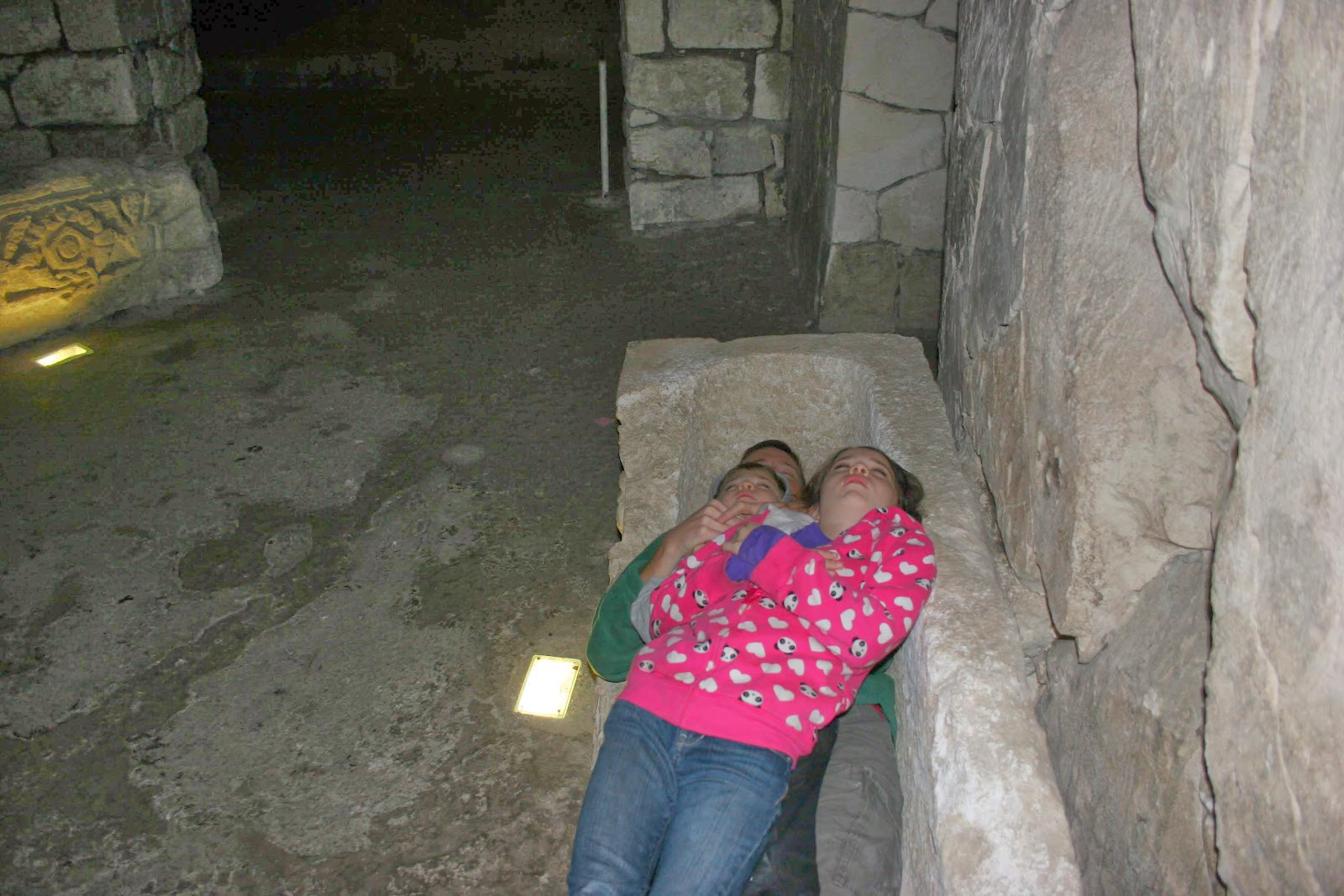

As we explored deep into the largest of the underground caverns, the outside world faded away and the dim light from the entrance made for great "scare your family" opportunities.


More photos here if you're interested.  Oh, and in case you're keeping count, this is park #6 of 66. 

Where swine fear to tread


That cliff look familiar?  Perhaps not... but you may have read about it before.  Here's how the account in Matthew goes:


28 When He came to the other side into the country of the Gadarenes, two men who were demon-possessed met Him as they were coming out of the tombs. They were so extremely violent that no one could pass by that way. 29 And they cried out, saying, “[a]What business do we have with each other, Son of God? Have You come here to torment us before [b]the time?” 30 Now there was a herd of many swine feeding at a distance from them. 31 The demons began to entreat Him, saying, “If You are going to cast us out, send us into the herd of swine.” 32 And He said to them, “Go!” And they came out and went into the swine, and the whole herd rushed down the steep bank into the sea and perished in the waters. 33 The herdsmen ran away, and went to the city and reported everything, [c]including what had happened to the demoniacs.

Kursi National Park is one more checkmark on our list of Israeli National parks to visit (5 down, 61 remaining).  The hilltop, with a commanding view of the Galilee, is the place where some believe the herd of swine mentioned in Matthew took their final swan dive into the Sea of Galilee below.


We were fortunate to happen across a group of student tour guides who volunteered to "practice" on us.  Back then, they told us, they believe the shores of the Galilee were a good deal higher than they are today.  This is now hosts the remains of one of the largest Byzantine monasteries in Israel, complete with mosaics and the ruins of an ancient chapel.


Saturday, December 28, 2013

Exploring the trenches of Castel

Today was a "plan C" weekend.  Plan A?  Go see "Frozen" with the kids.  One website said it was in English.  Another said it was dubbed in Hebrew.  The theater staff told us to call back today to find out.  Answer?  Hebrew. 

Plan B? Pack a picnic and head to the En Hemed National Park.  We got as far as the gate, which was closed... with a mysterious sign in Hebrew explaining why. 

So - to Plan C - the nearby Castel National Park, which was also officially closed.  When in Israel, though, do as the Israeli's do. After a picnic lunch at the playground below the park, we followed weekend hikers through a gap in the fence up the hill.  The view from the top was impressive.  Which would explain why this hill has been a strategic military outpost for centuries.  Guarding the road to Jerusalem, Romans, Crusader nights, Arabs and Israelis have all used this fortress to control travel into the Judean hills.


Today, there's nothing much left of the fortifications except for trenches and bunkers left behind by the Jewish Palmah commandos during the 1948 Arab-Israeli war. 

A great spot to take in the view, and explore the trenches (best explored while wielding a wooden sword or bow & arrow, of course).


 A bronze relief map and plaque describing the fortifications
Three generations of Milligan women in the fortifications

In case you're counting, that's four parks explored, 62 left.

Sunday, November 3, 2013

Herod was one bad dude

I've read and heard the stories hundreds of times: the journey to Bethlehem. Wise men visiting from the East.  A king named Herod with a little jealousy problem.  When you actually visit the places where these stories took place though, they take on a personality you never quite noticed before.  Kind of like actually tasting something you've only read about.


Just under seven miles away from our apartment, a volcanic cone looms over the dusty hills of Judea.  Only it's not really volcanic, and it's almost entirely man-made.  King Herod the Great commissioned Herodion as a family retreat of sorts - a vacation spot about 12 miles south of the hustle and bustle of Jerusalem.  The palace on top of the mountain and the grounds below included a royal theater, Roman baths, and luxurious accommodations for Herod and his family.  (If you have Netflix, check out this documentary for lots more details.)


There's not much left of the place now, but the excavated ruins give you a glimpse of what it must have been like.  You can imagine King Herod the Great, standing in one of his towers at the top of the mountain, surveying his domain.  


Just north across the rugged terrain of the Judean desert sits the town of Bethlehem, where 2000 years or so, something unusual was developing.


First, there was that odd star.  And then the visitors.  Learned men from the east, bearing strange gifts.  Perhaps those wise men even stopped here at Herodion to chat, (king-to-king, you know) as they chased the star across the sky.  

"Bethlehem?!" I can almost hear Herod exclaim as he glared across the valley.  "A new King, born in Bethlehem?  That little town over there in the shadow of my Herodion?"  

This is the same guy that had two of his sons and several of his wives killed to prevent threats to his rule.  When the visitors refused to play along, stop by for tea and spill the beans on the way out of town, Herod flipped.  There would be no new King from Bethlehem usurping his throne!  Matthew 2 picks up the narrative:

"16 When Herod realized that he had been outwitted by the Magi, he was furious, and he gave orders to kill all the boys in Bethlehem and its vicinity who were two years old and under, in accordance with the time he had learned from the Magi."

After giving the orders, he may well have retired to luxury royal box seats of his private palace to enjoy the latest in Roman theater.  Maybe he chilled out in the bathhouse, or enjoyed the fountains on the palace grounds.  No doubt about it, Herod was one pretty nasty dude.

The old bible story hasn't changed... but flavored with the smell of the dust wafting up off the hills, squinting in the midday sun under a bright blue sky, and surveying the same rugged mountains that Herod himself admired, the story resonates in a way it's never done before.  And that's what living in the Holy Land does to you.


Ancestors of Herod's Donkeys?

By the way, that's three parks down, 63 to go!


More photos here.

Sunday, September 29, 2013

Shloshing around in the Gan HaShlosa

National park visit number two this week was to the springs at the Gan HaShlosha National Park just west of Bet She'an.  To get there, we descended out of the Judean hills toward the Dead Sea, and then headed north on Highway 90, past Jericho (yes, that Jericho, where the "walls came tumbling down").  We pulled into the park after about an hour and forty minutes of easy driving on nearly deserted roads. 

The main feature of the "Park of Three" (Hebrew) or "The Hot" (Arabic) is the series of three natural pools that stay at a constant 80 degrees or so, year around.  On a warm September day like today, they just felt "refreshing." 


There's a kids' wading pool, and two larger pools, with waterfalls connecting them all, before the stream that feeds the pools runs past an ancient mill and carries on its merry way out of the park.  The waters are clear... which gives you a clear view of all the trash at the bottom of the pools.  We caught plenty of "plastic bottle fish", along the occasional "platefish" or "forkfish."


The pools' real-life fish are very inquisitive (though much too fast to catch with our assortment of kids' toys) and give you a gentle pedicure if you'll let them.


Green lawns and lifeguard stands surround the pools.  Barbeque grills dot the park, and there's a restaurant if you forget to bring your lunch along.


A great spot for a lazy day of lounging by the poolside!  Two parks down, 64 to go!


More photos here!

Saturday, September 28, 2013

Excursions in Israel - Bet Guvrin Maresha National Park and the Bell Caves

We're officially "wheeled!"  Our van is finally here, licensed, registered, insured and road-ready.  We hit the trails this week with our first trip out of Jerusalem - to the Bet Guvrin Maresha National Park.  Just 45 minutes away from our perch in Holyland park, we headed down out of the hills of Jerusalem, descending through Ein Kareem and winding through the valleys to the flat plains of Maresha below.  The same plains where King Asa of Judah met and defeated an invading army from Ethiopia (2 Chronicles 14).  


No Ethiopians anywhere in sight today, but we did find plenty of interesting caves to explore.

This area has been known for centuries for its mines and quarries - the top meter or so of hard surface rock gives way to softer chalky rock beneath.  The bell-shaped caves resulted from the top-down mining techniques common to this area.  The miners "cracked" the top shell, and then dug down into the softer chalk, widening the caves as they went deeper, and pulling the quarried rock (and hopefully the miners too, at the end of the day) up through the hole at the top.  


The entrance to the Bell Caves complex today is via an arched doorway, leading to the cool shadows of the caverns beyond.


Ancient chisel marks were still very much in evidence as we explored the cave complex - a linked collection of several former bell-shaped caves, now accessible via well-maintained trails throughout the park.  


With the chimney-like entrance holes some 50-60 feet above our heads, the chiseled walls curved above our heads to form natural archways.  Pockets of harder rock left behind by the miners formed fascinating formations along the walls, and far above our heads, a colony of bats squeaked and rustled in dark corners.

After exploring the Bell Caves, we headed back up to the surface before driving a short way to the remains of the Biblical city of Maresha on a Tel (hill) to the north of the caves.  Several more caves to explore here: the burial caves prompted the kids to go searching for mummies, and strike their best "Zombie" poses.


Our last stop on this trip was a scrabble up the side of the Tel, and then deep underground into a deep cistern complex.


That's all for this update... lots more photos of this trip available here.  

With 65 more National Parks to visit, and a brand new National Parks pass in hand, there's plenty more yet to see!